
Douglas County Property Value Types
Value is not one number. Douglas County assessment data splits a parcel into land, improvements, and a total assessed value. Each part answers a different question. A sale price belongs to the deed record. A market estimate is an assessor's calculation. The source and the year tell you which figure you are reading.
| Value | What It Is | Where |
|---|---|---|
| Assessed value | Value carried in the assessment roll for the parcel and year | GCS or municipal assessment roll |
| Estimated market value | Assessor estimate based on the applicable ratio and assessment method | Assessment record or city explanation |
| Recorded sale price | Consideration stated in a transfer record when available | Recorded deed or transfer instrument |
| Land and improvements | Separate components contributing to total assessed value | Assessment roll |
An assessed value exists for taxation. It can sit well above or below a recent sale price. Wisconsin's assessment ratio reports compare assessed amounts against sales, but only at the community level. A ratio is no substitute for an individual appraisal. Applying one to a parcel without the right class, municipality, and year invites error.
Douglas County's Assessment Roll Separates Values
An equated roll entry from 2025 shows what a Douglas County assessment roll can hold. Land value, improvement value, and total value sit alongside acreage. The owner of record, a mailing address, and the legal description sit there too. School and special-district headings appear too. The example is a manufacturing parcel with its own aggregate ratio. That makes it a useful illustration, but it is not a residential parcel card. Do not apply its ratio to a home.
For an ordinary residential parcel, the exact value labels, sales history, and last-sale fields depend on the live record. Open the parcel entry and check its assessment year and value components. No sale price may appear on the screen. Pull the recorded deed or ask the assessor how the value is shown. Superior posts assessment rolls and review records for its city parcels.
The roll splits land value from improvement value, and the parcel's class and year govern how to read both.
Douglas County Assessment Ratios Are Not Rates
An assessment level is not a tax rate. Wisconsin DOR's aggregate ratio compares assessed values with usable sales. It does this for a whole community or property class. Douglas County materials describe 2025 residential assessment structures of 6.25 percent for local government. Schools come in at 7.05 percent. Other classes follow different rules. Those percentages describe assessment structures. They are not a parcel's sale value or the rate on a tax bill.
DOR announced the final 2025 sales and assessment-to-sales ratio reporting in March 2026. Match the report year, municipality, and class when you look one up. A ratio summarizes a market relationship across a group of properties. It cannot tell you what one house should sell for. Wisconsin DOR's ratio explanation describes how aggregate reports are used.
Look Up Douglas County Property Value
Start with a parcel number or street address. That opens the assessment record for the parcel. Keep the assessment year and municipality attached to whatever figure you pull. If you need a sale price, the recorded deed is the place to look, since the assessor's residential card does not always carry an estimated market figure or sale history.
- Find the parcel in GCS or the municipal assessment roll and record the tax number.
- Write down land, improvement, and total values with the assessment year and parcel class.
- If the card shows an estimated market value, note the method and ratio context supplied by the assessor.
- For a recorded sale price, locate the latest deed and keep its transfer date separate from the assessment date.
- Assessed value
- The value carried in the assessment system for a stated year.
- Market value
- An estimate of likely exchange value, not necessarily a recorded sale.
- Assessment ratio
- A community-level comparison of assessments with sales for a class and year.
- Sale price
- The consideration recorded for a specific transfer, if shown in the instrument.
Douglas County Sale Prices Live in Deed Records
Douglas County sale prices live in deed records. A deed names the parties, gives the legal description, and carries the recording date. Many deeds also state the consideration. The assessor portal's parcel card does not reliably display last-sale figures, so the deed index settles any question about a recorded transaction, which proves one sale rather than a current appraisal of the property.
Deed images on LandShark begin in April 1961. Earlier transfers sit in the tract index books at the Register of Deeds office. A party name or parcel number finds the image. The legal description is what confirms the deed covers the same land.
Tax bills are separate. For amount due and payment status, use the Douglas County property tax records route.
Superior Property Values Have a Roll Year
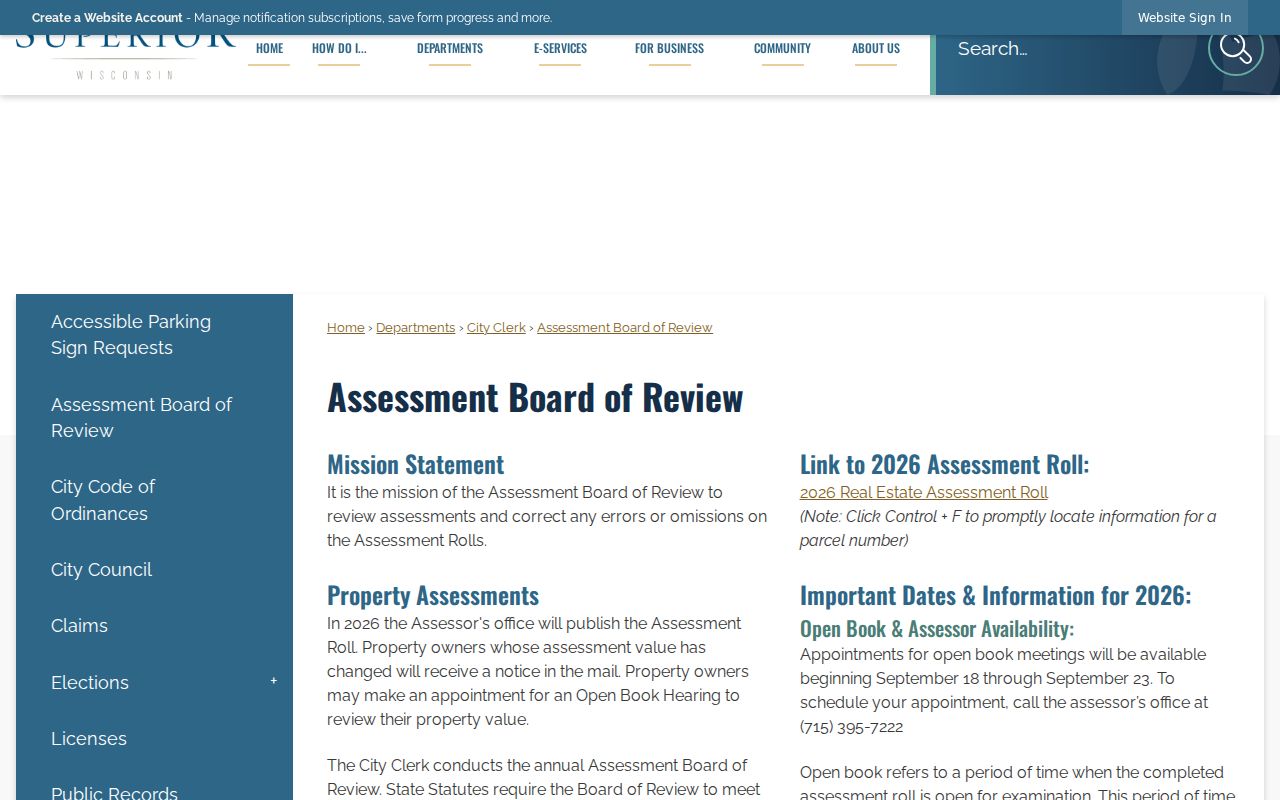
Each Superior value belongs to a roll year. The city posts assessment rolls for 2021 through 2026 on its Board of Review page. Its 2024 revaluation notice laid out a staged assessor review, mailed notices, an Open Book discussion, and a later Board of Review appeal. Superior's schedule stops at the city line. Lake Nebagamon, Solon Springs, and unincorporated Douglas County parcels follow their own roll years.
The city's own explanation says a tax bill's estimated fair market value is a municipal estimate built on the DOR ratio. It is not a listing appraisal. A new roll, a recorded sale, and a market estimate can show different numbers and dates. Superior explains assessed versus estimated market values for city properties.
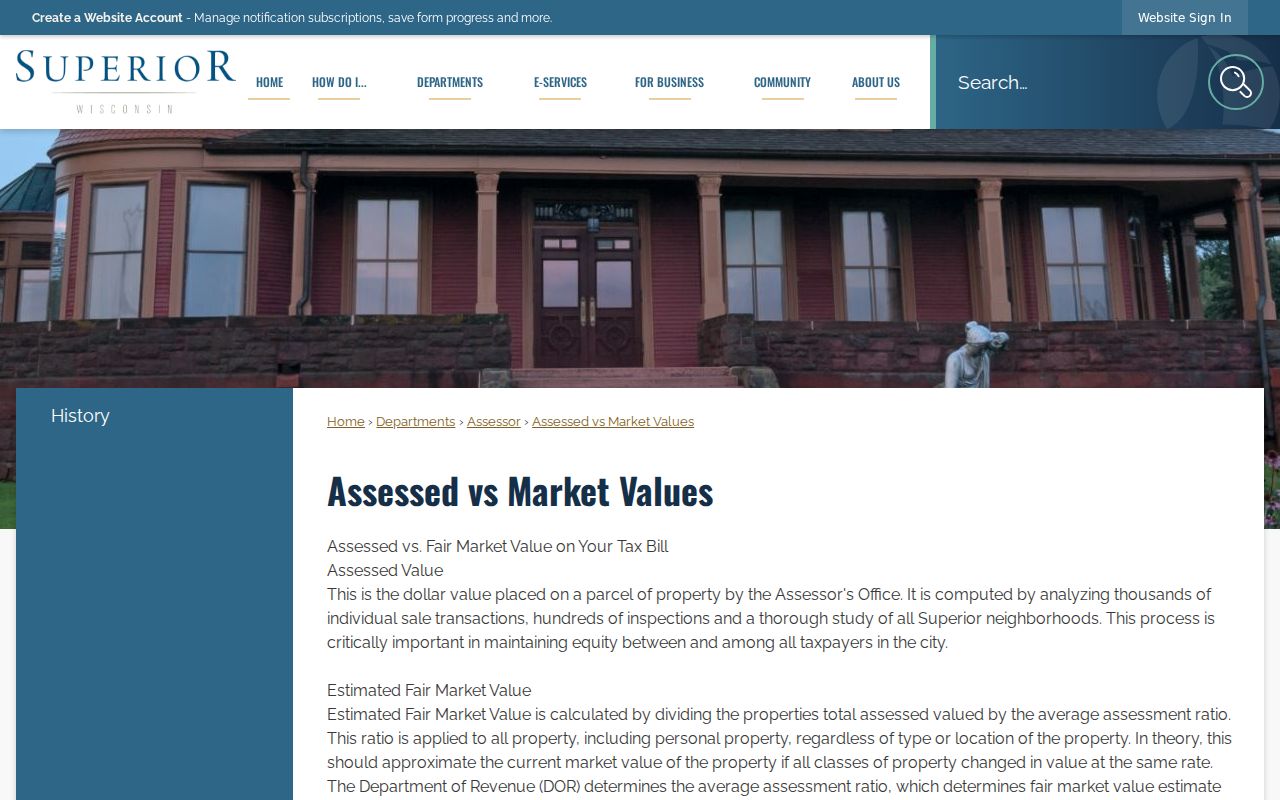
It explains the assessor's estimate, not an individual sale.
Douglas County Values Need the Right Comparison
Numbers only mean something next to the right neighbors. Compare parcels from the same assessment year, the same class, and the same municipality. Match value components too. The DOR's 2025 report draws on usable sales and assessment-to-sales analysis, so it describes broad ratios rather than a sale estimate for each individual parcel.
Class matters more than people expect. A manufacturing roll ratio belongs to manufacturing property. Carrying it over to a residential parcel produces a false comparison.
When an assessment looks out of step, review the physical description and the assessment year with the assessor. Appeal deadlines sit with the tax record. So do annual local dates. A market opinion is a different service, and a licensed appraiser supplies an individual valuation for a sale or other private purpose.
The 2025 residential structure splits its rates. Local government applies 6.25 percent. Schools apply 7.05 percent. Neither figure is a tax rate charged to one owner, nor proof that a home is worth a fixed percentage of a sale price. County materials also flag 2026 changes, so keep the reporting year attached to any comparison.
Before comparing two parcels, verify municipality, class, land and improvement components, and roll year. The 2025 sample roll covers manufacturing property. It illustrates field structure, but it cannot stand in for a residential assessment. A suspicious comparison deserves a question to the assessor about parcel characteristics, with the current local Open Book or Board of Review notice as the formal path for a challenge.
Keep four numbers distinct in any comparison file. Those are the parcel's assessment components for the year, the DOR ratio for the relevant municipality, a recorded sale price with its deed date, and the tax bill after the applicable levies. A gap between them is not automatically a record error. Different dates, property classes, municipal boundaries, or purposes can explain it.
What a Douglas County Assessor Value Cannot Tell You
A Douglas County assessment answers a tax question. It is not a buyer's offer, a listing value, or an appraisal of a specific property. Timing, class, ratios, and parcel attributes all shape the number. The record may not reflect a recent change in condition or sale, so treat it as a starting point rather than a market verdict.
Value vs price. A Douglas County assessor value is not what a parcel will sell for. Use a licensed appraiser for an individual market valuation.